

VR
What Is Immersive Technology? AR, VR and XR Explained
Mobiddiction ·
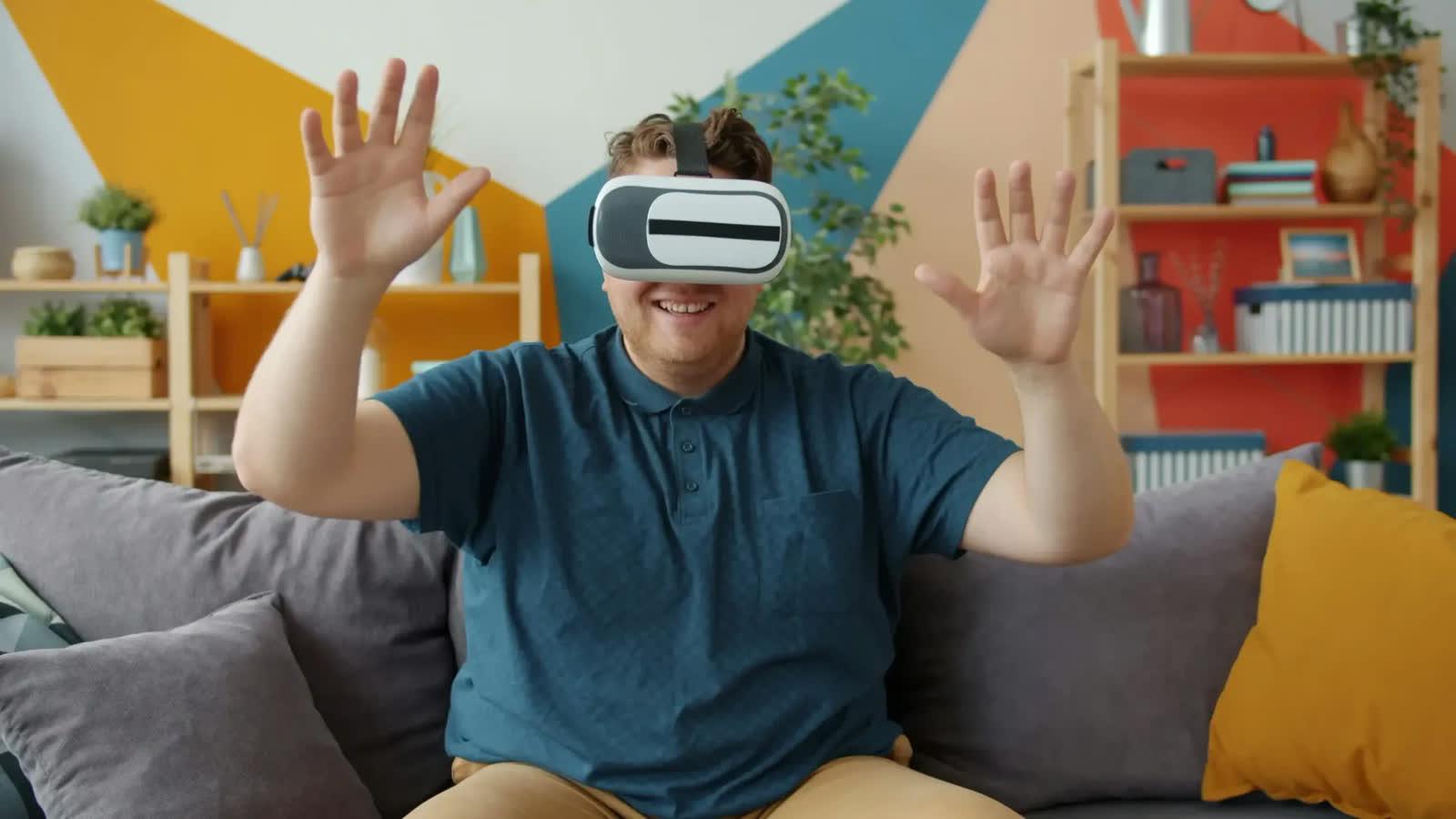
Immersive technology refers to digital tools that either simulate a real environment or enhance one with digital content. Put simply, it lets people experience information instead of just reading it. That is why Australian organisations use it to reduce training time, improve safety and help teams collaborate across locations.
AR, VR, MR and XR in simple terms
All of them alter your perception of reality using a headset, glasses, or the phone in your pocket. The difference is how much of the real world they leave in place.
Augmented reality (AR)
AR overlays digital information (images, text and other interactive virtual elements) onto the real world in real time. A smartphone or tablet uses its camera, sensors and software to detect and track your surroundings, then adds digital content to them, so you keep moving freely and stay aware of what is around you. If you have chased a Pokemon or used the IKEA app, you have used AR; Google has also added an AR mode to Maps. The term was coined in 1990 and first appeared in the work of researchers at Boeing.
Virtual reality (VR)
VR replaces the real world entirely. It is a computer-generated simulation of a three-dimensional environment that you interact with using specialised equipment: a headset, and sometimes gloves or other sensory input devices. The headset shows a stereoscopic view while headphones provide spatial audio, and you explore by moving your head and body. The first head-mounted display, the “Sword of Damocles”, was built by a university computer science professor in the 1960s; the term “virtual reality” was first used by Jaron Lanier.
Mixed reality (MR) and extended reality (XR)
Mixed reality blends the two, so physical and digital elements interact. XR is the umbrella term covering AR, VR, MR and everything in between. So: AR adds to the real world, VR replaces it, and XR is the whole family.
Why immersive technology stopped being experimental
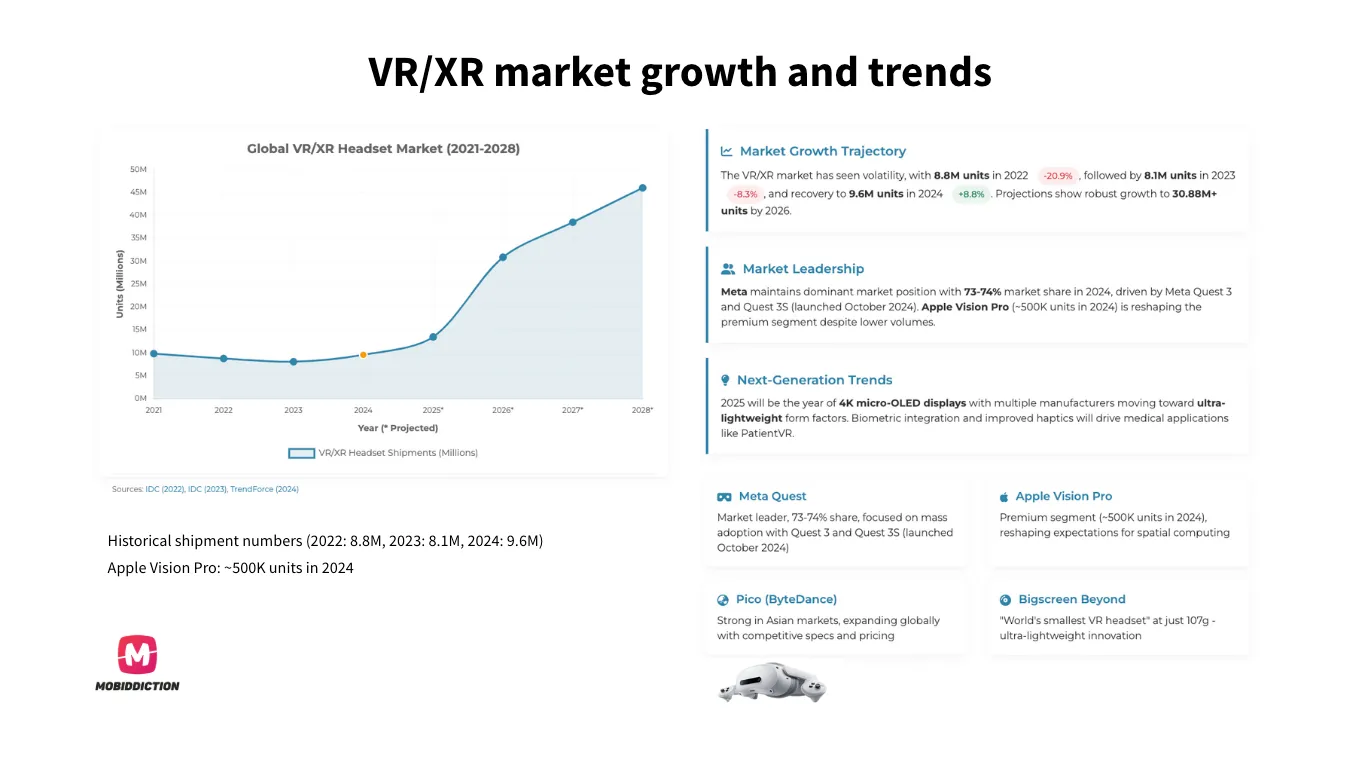
VR spent a long stretch stumbling through false starts: expensive headsets, clunky hardware, pilot projects that rarely scaled. What changed is unglamorous but decisive: hardware is lighter, cheaper and more portable; AR applications run on everyday devices; software is easier to customise and scale; and enterprises now invest in platforms rather than one-off experiments.
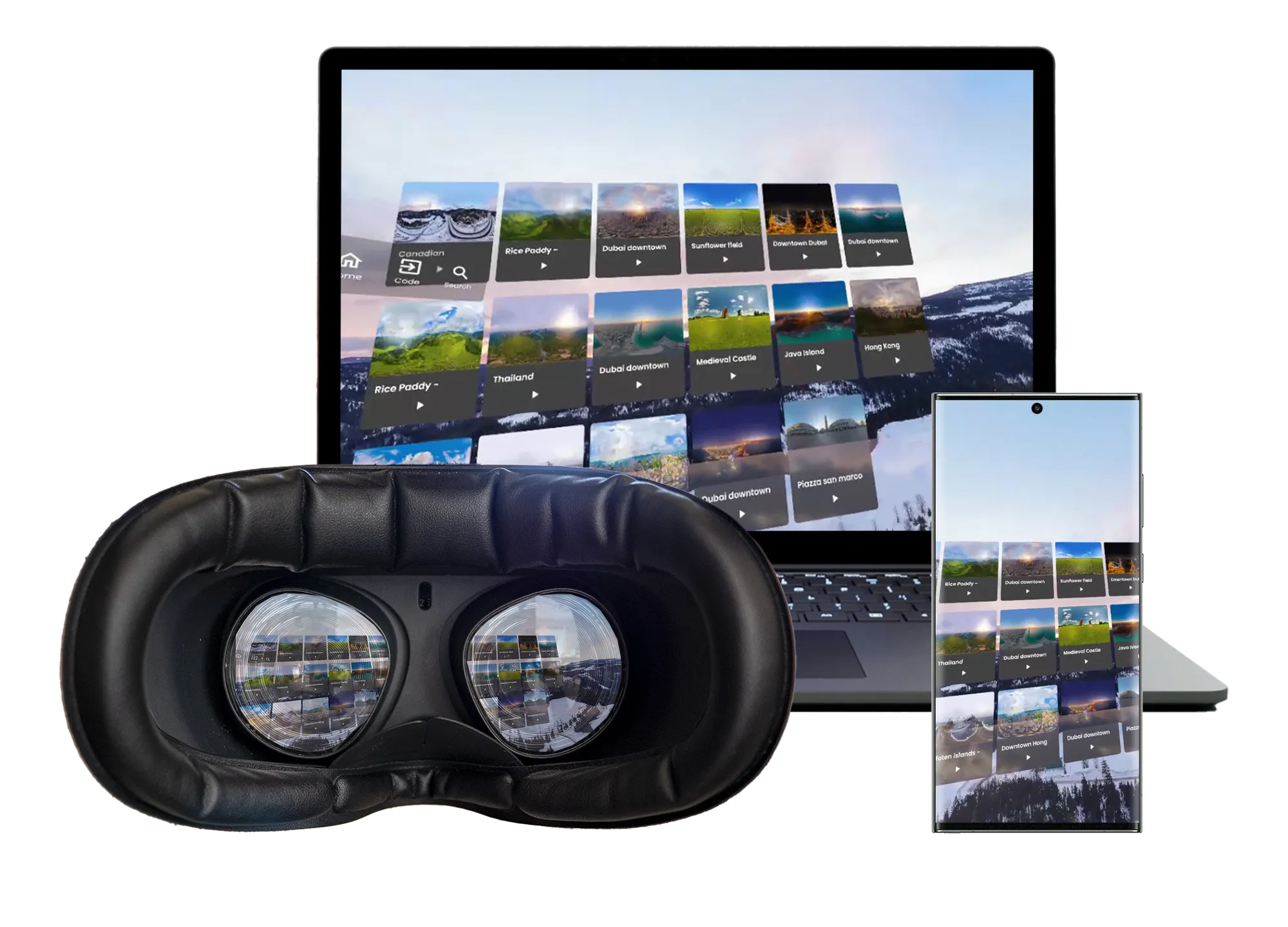
Our own hardware journey tracks that curve: Mobiddiction started with Google Cardboard for 360° content, moved to the MetaQuest 2, and today builds for the MetaQuest 3 and 3S with head tracking and controller-free gesture recognition, plus the MetaQuest Pro with eye tracking. Apple has since joined with the Vision Pro.
The market has followed. As cited in 2025, the global VR market is projected to reach $382.87 billion by 2033, up from $43.58 billion in 2024, a CAGR of 27.31% from 2025 to 2033 (GlobeNewswire), with healthcare VR alone expected to reach $25 billion by 2030 (Vention).
How VR and AR improve business processes
Training and safety
Training in VR places employees in realistic scenarios with no real-world risk: high-risk site simulations, emergency response drills, equipment operation and customer service scenarios. People learn by doing rather than watching, improving knowledge retention and reducing workplace errors. Demand is growing for “best start” use cases too: career taster programs, onboarding and OH&S-style safety training.
Remote collaboration
VR lets teams meet in shared virtual spaces regardless of geography. Instead of email threads and video calls, collaborators walk through designs, optimise workflows and brainstorm together.
Design and planning
Rather than reviewing 2D plans on a screen, stakeholders can step inside digital models. Architects, engineers and product teams review projects together in shared 3D spaces, spotting issues earlier, reducing costly rework and approving plans faster.
On-the-job support
AR overlays instructions and data onto the real world, so staff can follow step-by-step repair instructions, run quality checks with visual cues and get remote guidance from experts, reducing downtime without asking staff to memorise complex processes. As PTC’s executive vice president of augmented reality products, Michael M. Campbell, put it, AR is “…well-suited for industrial use cases, particularly workforce training and product maintenance.”
Sales and customer experience
AR helps customers visualise products in their own environment before they buy by seeing how equipment fits onto a worksite, or how a product looks in situ. Retailers, automakers and real estate firms let customers explore before committing, which improves confidence and speeds up buying decisions.
Immersive technology in healthcare
Health is where the evidence base is strongest. VR has been shown to reduce patient-perceived pain levels and procedure-related anxiety. Research cited in 2025 shows it can reduce perceived pain by 24% during medical procedures by creating powerful distraction. VR rehabilitation therapy can simulate real-life situations to improve physical function after a stroke or other condition. It can also incorporate meditation, cognitive behavioural therapy and mindfulness. According to recent studies, 82% of healthcare professionals agree that VR creates a convenient way of accessing information that benefits both patients and practitioners (ScienceSoft, cited 2025).
PatientVR is Mobiddiction’s virtual reality program for patient pain management, staying connected and wellbeing. It was developed over two years and has been trialled with NSW Health at Nepean Palliative Care and with QLD Metro South Health at Logan Hospital. The Nepean trial ran with Our Community Cares, a community-funded Penrith charity that sponsored the headsets used on the ward. It joined Investment NSW’s Going Global Export Program 2023–24, focused on health innovation in the United Kingdom.
PatientVR runs on M4 (formerly Mobiconnect), our multi-tenant platform. Its sign-in, workspaces, media and notifications come from the M4 core. Streaming for large stereo VR video is extended for PatientVR, and headset pairing, monitoring and per-headset content are a custom module crafted only for it. See PatientVR.
The Virtual Reality patient experience is one of its kind for Hospitals and it has a specific design and implementation for use in the health care sector, we worked on this for several months in partnership with healthcare experts, health care community and professional organisations.
Alongside it sits HealthVR, a collection of calming, interactive environments designed with specialists to help young patients manage phobias and anxiety with minimal to no hand movement during IVs and cannula insertions. Rocket Crew was a four-day VR activation created with the Starlight Children’s Foundation for the Starlight Express rooms at Sydney Children’s Hospital, Randwick.
Australian AR and VR examples
Sydney ThundAR, developed for HomeWorld, is a native iPad app built with the iOS ARKit. Face detection recognised the shape, size and contour of a fan’s face and painted Sydney Thunder themed filters onto it, with textures crafted by our UI/UX team so the result looked close to real face paint.
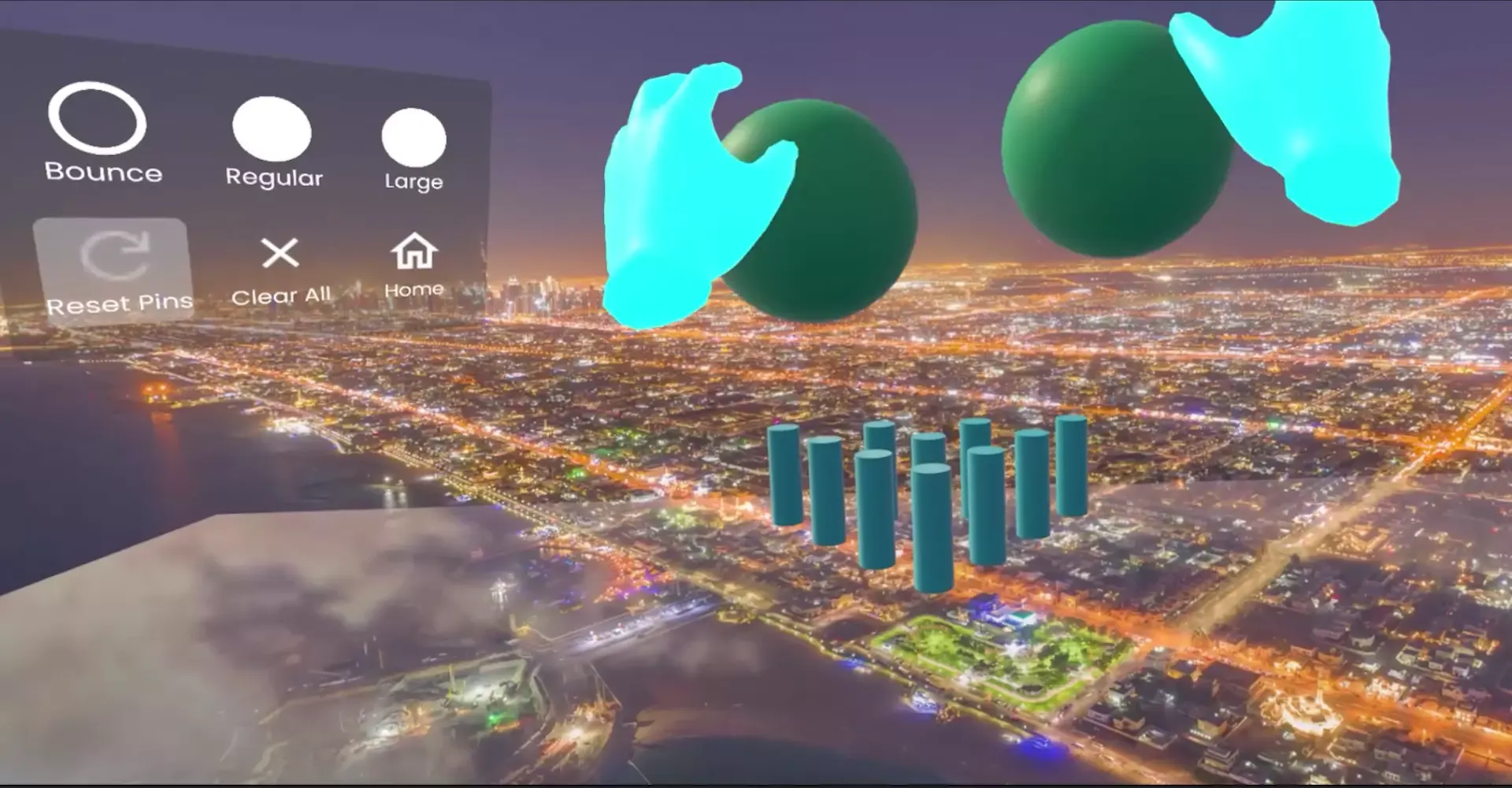
Virt-Real was our VR 360° events platform, with multiple rooms, galleries and live chats. For telecommunications company Genesys we presented a virtual “Sydney Bus Tour” that introduced the city to global attendees across time zones, with no app download.
VapingVR is an early-intervention education experience for teens and young adults. Built in Australia with gesture-based interaction and no controllers, it is set inside a stylised version of the lungs and comprises three modules (Addiction, Brain and Lungs) plus an interactive quiz. It is available on the Meta Horizon Store.
Choosing the hardware
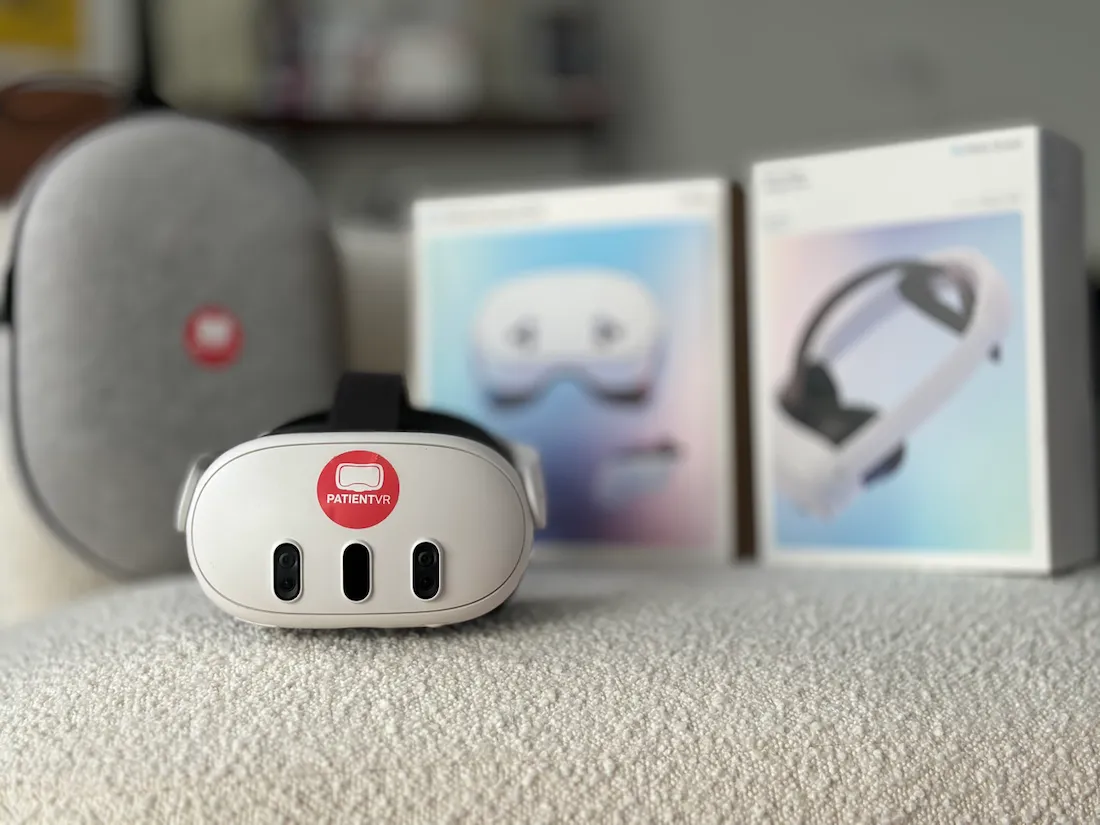
Hardware choice matters in a clinical setting. For patient VR we recommend a Meta Quest 3S (128) at an official guide price of $499.99 AUD, an Elite Strap at $119.99 and a carry case at $119.99, a total estimated kit price of $739.97. These are guide prices as published in February 2026, so check current pricing with Meta. The cloth strap in the box cannot be disinfected and is hard to fit; the Elite Strap wipes down with the agent you use on a TV remote and adjusts with a knob. PatientVR does not support the MetaQuest 2. Use the 3 or 3S, which are lighter, higher resolution and easier to clean. Sanitise plastic parts with antibacterial, use a lens spray cleaner on the camera and lens, and define the boundary in which VR mode operates so the headset switches to camera mode if the patient moves beyond it.
Getting started with immersive technology
Immersive technology is not a magic wand. The real challenges are content creation and planning, change management, and choosing the right first project. The organisations that succeed start with a problem, not with the technology. Nor is it enterprise-only: many businesses begin with a pilot VR training module, an AR sales application, or one operational use case, then scale with minimal risk.
A successful program runs from discovery and ideation through experience design, build, and testing for accessibility, comfort and technical compliance, to deployment (MetaQuest Store, enterprise sideloading, or MDM kiosk mode) and ongoing support. Construction, mining, manufacturing, healthcare, education, logistics, retail and property are among the sectors seeing the strongest value.
If your business trains people in complex tasks, faces safety or operational risks, needs better collaboration, or wants clearer product and space visualisation, immersive technology is worth exploring. Browse our immersive tech and innovation work, our case studies and PatientVR, then get in touch to talk through practical next steps, not just demos.
More reading

VR · Health
Mobiddiction selected for NSW Government’s Going Global Export Program
Mobiddiction joins NSW Government’s Going Global Export Program 2023–24, boosting PatientVR’s UK expansion with mentorship, market insight & export support.
Read article
Mapping · Digital transformation
What is Digital Wayfinding?
Learn what digital wayfinding is from spatial orientation and signage to AR indoor navigation and how it helps people navigate complex environments.
Read article
Technology · Digital transformation
Technology Consulting in Australia: Where a Program Starts
What a technology review covers, what it should leave you with, and how its findings turn into a program assembled on one managed platform.
Read article
Turn the ideas in this article into a working program
We assemble and run Government and Enterprise programs on M4, our multi-tenant platform. Tell us what you are working on.